
POLISH STANDARD – Standard No. 336
(Spanish Water Dog)
Revision of the Polish translation by Mirosław Redlicki, December 2022
ORIGIN :
Spain.
DATE OF PUBLICATION OF THE CURRENT TEMPLATE :
01.10.2019.
USABILITY :
A herding dog, a hunting dog, and a fisherman’s helper.
FCI CLASSIFICATION :
Group 8: Retrievers, Flushing Dogs, and Pointing Dogs. Section 3: Working Dogs.
Portfolio samples are optional.
A BRIEF HISTORICAL OVERVIEW:
These dogs have been found on the Iberian Peninsula for a very long time, and they all share the same origin,
like French barbet dogs. They are most common in Andalusia, where they are used as dogs
sheepdogs; there they are called “Turkish dogs.” Characteristics of Spanish Water Dogs, and
especially their distinctive fur, which is an adaptation to the environment of the marshes
are interspersed with dry hills. These dogs are used to help with herding,
waterfowl hunting and fishing.
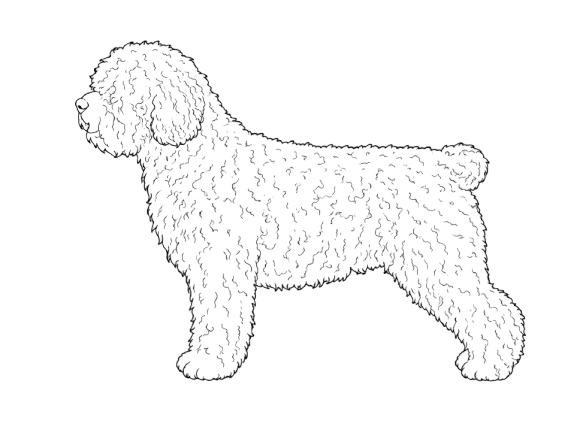
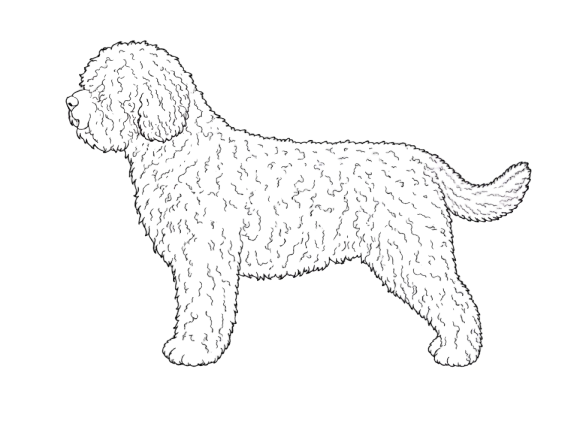
OVERALL IMPRESSION :
A country-type dog, well-proportioned, of medium weight, with an elongated, rectangular
He has a well-defined physique, is well-muscled, and is athletic thanks to his physical activity. His eyesight, hearing, and sense of smell are
well-developed.
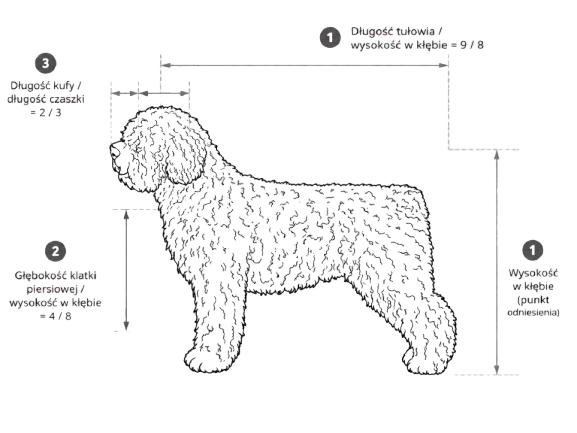
IMPORTANT PROPORTIONS:
– Torso length / height at the withers = 9 / 8.
– Chest depth / height at the withers = 4 / 8.
– Muzzle length / skull length = 2 / 3
BEHAVIOR / TEMPERAMENT:
Loyal, obedient, cheerful, well-balanced, and alert, capable of hard work. Thanks to
Highly intelligent, he learns very quickly and is able to adapt to a wide variety of
conditions and cope with a wide variety of situations.
HEAD :
Strong, worn with elegance.
CRANIUM :
Skull: Flat, with only a slight occipital crest. Parallel profile lines. Stop:
Mild, only slightly noticeable.
TRIPLE-TIMED :
Straight profile.
Nose: Well-developed nostrils; the nose should be the same color as the darkest shade of the coat, or
a little darker.
Lips: Tight-fitting, with clearly defined corners.
Jaws/Teeth: White teeth, well-formed, large canines.
Eyes: Set slightly obliquely, very expressive, ranging in color from hazel to chestnut,
that matches the ointment. The conjunctiva is not visible.
Ears: Set of medium height, triangular, hanging.
NECK :
Short, well-muscled, without a dewlap, well-set at the shoulders.
TORSO :
Sturdy. Top line: Straight.
Neck: Barely visible.
Back: Straight and strong.
Slope: Slightly downward.
Chest: Broad and deep, with well-sprung ribs and good capacity, which ensures a large
respiratory capacity.
Bottom line: My stomach is a little tighter.
TAIL:
Set moderately high, docked to a length of 2–4 vertebrae. Some dogs have tails with
short in nature.
LIMBS :
FORE LIMBS:
General Appearance: Strong and upright. Shoulders: Well-muscled, set at an angle.
Shoulder: Strong.
Elbows: Close to the body, not turned out.
Forearm: Straight and strong.
Wrist and metacarpus: Straight, rather short.
Paw: Rounded, toes close together, claws of various colors, strong pads.
HIND LIMBS:
General Appearance: Perfectly vertical, not too deeply angulated, well-muscled, giving a strong
propulsion, essential for efficient movement and smooth jumps.
Thigh: Long, well-muscled.
Lower leg: Well-developed.
Jumping height: Low.
Metatarsus: Short, lean, and upright.
Paw: Rounded, toes close-set, claws of varying colors, strong pads.
GAIT: The preferred gait is a trot.
SKIN: Thin, elastic, and close-fitting all over the body. Black pigmentation or
chocolate-colored, depending on the coat color. The same applies to the mucous membranes.
FORMAT:
COAT: Always curly and woolly; when not trimmed, it can form mats.
The coat may be clipped to a uniform length all over the body; under no circumstances may it
its purpose is to “beautify” the dog.
Recommended coat length for show dogs – up to 12 cm (up to 15 cm when stretched out)
(curls), after a haircut—at least 3 cm—so that its structure can be assessed. The coat
The puppies' fur is always curly.
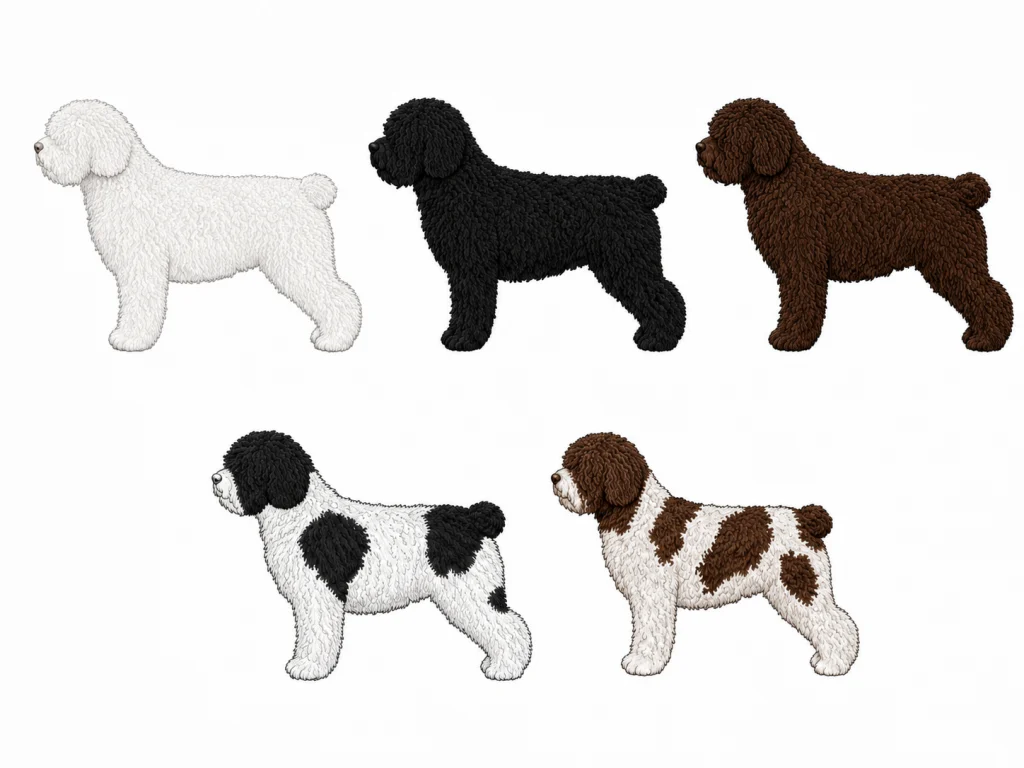
OINTMENT :
Solid: white, black, and chestnut in various shades.
Two-tone: white and black, and white and chocolate with patches in various shades.
Tri-color coat, black with tan markings, and chestnut with Arson is unacceptable.
SIZE AND WEIGHT:
Height at the withers: males 44 to 50 cm, Females: 40 to 46 cm. Acceptable
a deviation of no more than 2 cm for both sexes, under a prerequisite for maintaining
harmony of form.
Weight: dogs 18–22 kg, female dogs weighing 14–18 kg.
DRAWBACKS:
Any deviations from the above standard should be considered defects and
assessed based on their severity and impact on health, fitness, and well-being
the dog's well-being.
MAJOR DISADVANTAGES:
The spine is noticeably sunken.
Abnormal limb structure.
The belly is hanging down or tucked in.
DISQUALIFYING DEFECTS:
Aggression or obvious fearfulness.
Obvious physical defects or personality disorders.
Overbite or underbite.
Wolf claws.
The coat is smooth or wavy.
Albinism.
Spotted or speckled coat, tan markings.
An unbalanced nature.
NOTE:
Males should have two normally developed testicles that are completely located within
scrotum Only functionally and clinically healthy animals may be used for breeding
dogs with a typical appearance for their breed.