POLISH STANDARD - Standard No. 105
(Barbet)
Polish version: April 2010
ORIGIN :
France
DATE OF PUBLICATION OF THE CURRENT TEMPLATE :
21.02.2006.
USABILITY :
A dog bred for hunting waterfowl; like other water dogs, it is more than just a retriever: it searches for and flushes out birds hidden in thickets and reeds, and retrieves the shot game. Highly resistant to cold, it should enter the water regardless of the weather.
FCI CLASSIFICATION :
Group 8: Retrievers, Flushing Dogs, and Pointing Dogs. Section 3: Working Dogs.
A trial period applies.
A BRIEF HISTORICAL OVERVIEW:
A very old breed, common throughout France, used for hunting waterfowl. It was first described as early as the 16th century.
OVERALL IMPRESSION:
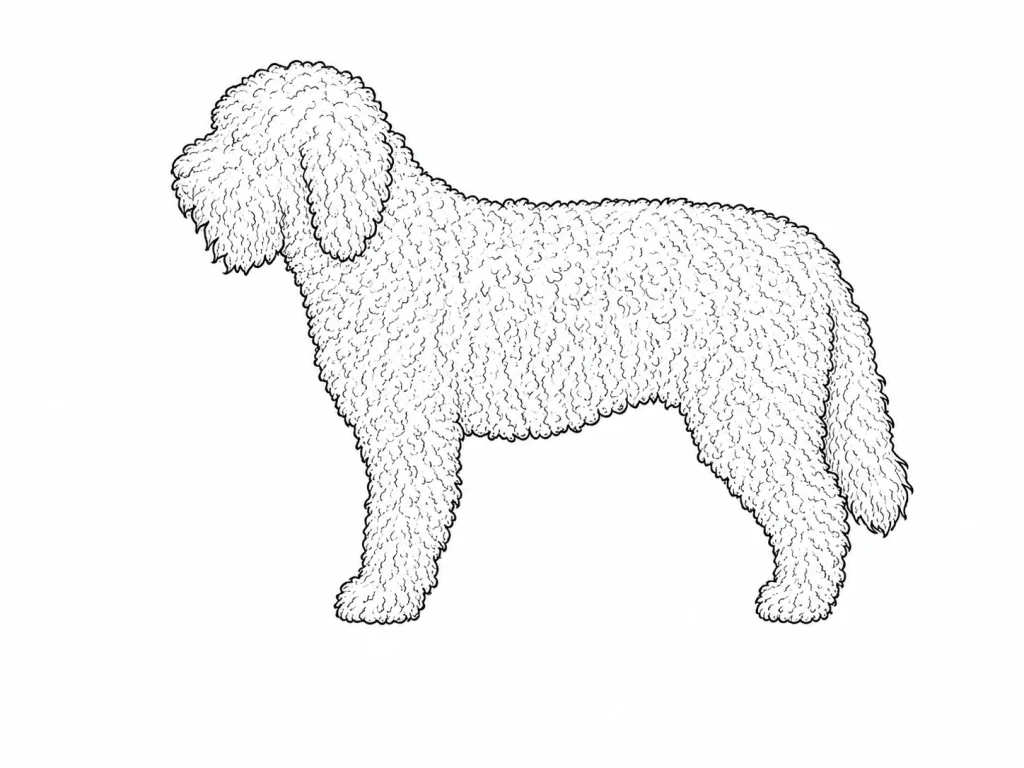
A medium-sized, natural-looking dog with a thick, woolly coat that provides excellent protection against cold and moisture. The coat forms a beard (barbe in French), hence the breed’s name—Barbet.
IMPORTANT PROPORTIONS:
The muzzle is slightly shorter than the skull
The length of the torso is slightly greater than the height at the withers
BEHAVIOR/TEMPERAMENT:
Calm, very attached to its owner, sociable, loves water—even very cold water.
HEAD:
The hair on the head extends all the way down to the bridge of the nose. The beard is thick and long, and the mustache covers the entire length of the muzzle.
CRANIAL BASE:
Skull: Rounded and broad. Stop: Distinct.
TRZEWIOCZASZKA
Nose: Large, with well-flared nostrils; black or chocolate-colored, depending on coat color. Muzzle: Rather angular. The bridge of the nose is broad. Lips: Thick, well-pigmented, completely covered with long hair. The edges of the lips are black or brown. Teeth: Jaws of equal length. Scissor bite; strong teeth; incisors large and evenly spaced. Eyes: Round, preferably dark brown. Eyelids black or brown. Ears: Set low (at eye level or lower), long, flat, covered with long, cord-like hair. When laid flat against the muzzle, the ears extend at least 5 cm beyond the nose, and the auricle itself extends beyond the corner of the lips.
NECK:
Short and to the point
TORSO:
Back: Strong and firm. Loins: Arched, short, and strong. Croup: Rounded; when viewed from the side, it is a smooth extension of the loins. Chest: Broad, capacious, deep—reaching to the elbow, rounded but not barrel-shaped
TAIL:
Slightly raised, carried above the level of the back when in motion, set low, with a hook at the end
HIND LIMBS:
Thigh: Set at an angle, well-muscled. Hock: Low, well-angulated. Metatarsus: Vertical.
PAW:
WALKS
Large, round, and very hairy. : Free-moving; the limbs move parallel to the midline of the torso. Moderately long stride, powerful drive from the hind legs.
LEATHER:
Relatively thick.
FORMAT:
COAT: Long, woolly, and curly; may form cords. It covers the entire body evenly and looks natural—this natural appearance is an essential characteristic of the breed. Coat styling is permitted only to the extent that it benefits the dog in its work or facilitates daily grooming.
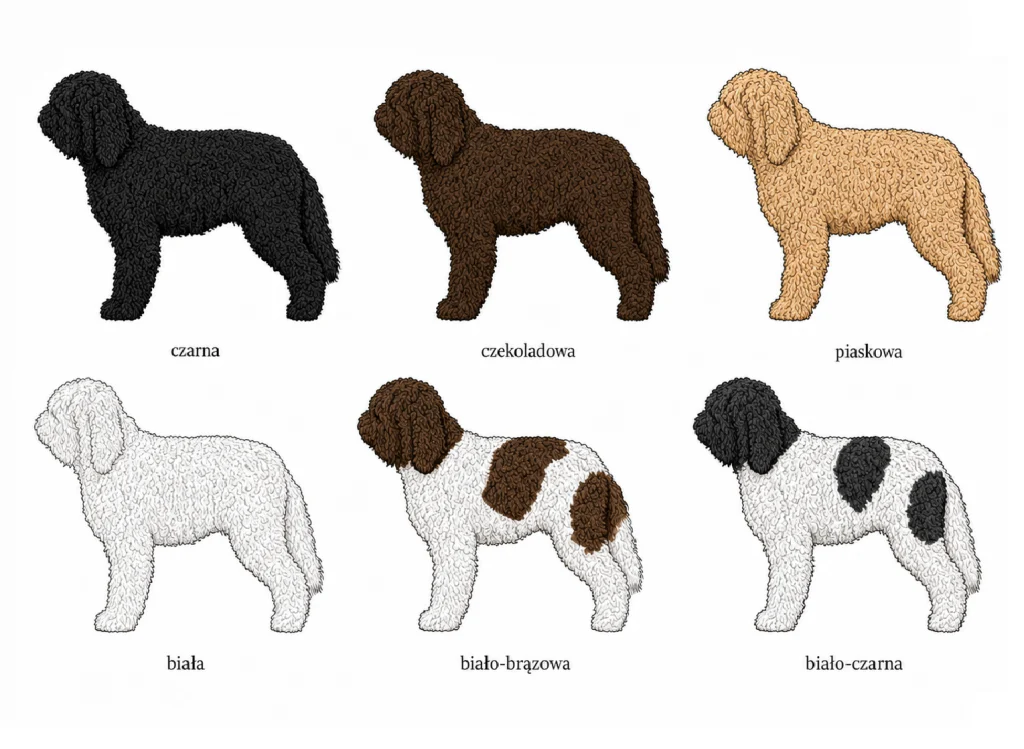
COAT COLOR: Solid black, gray, chocolate, fawn, sandy, or white; spotted with patches of varying sizes. Various shades of fawn and light fawn are acceptable. A uniform shade throughout the body is desirable.