
THE DOG OF THE SEA, THE MOUNTAINS, AND THE MARSHES
The Spanish Water Dog is considered one of the oldest working breeds of the Iberian Peninsula. Over the centuries, it has developed primarily as a versatile companion to humans: a herding dog, a guard dog, a retriever, a fishing dog, and, above all, a dog that works alongside humans. The breed’s history, however, is far more complex than the modern breed standard and remains partly shrouded in mystery to this day.
The exact origin of the Spanish Water Dog has not been definitively established. However, it is known that dogs with curly coats and a working disposition have long been present in what is now Spain. The official FCI breed standard indicates that the breed has been present on the Iberian Peninsula for centuries and shares common roots with other European water dogs, including the French Water Dog. One of the most frequently cited theories points to North African influences. Dogs of a similar type may have arrived in southern Spain along with populations migrating between North Africa and Andalusia. Other sources trace the breed’s origins to the ancient trade routes of the Mediterranean basin. References to the maritime trade route between Spain and the territories of the Ottoman Empire frequently appear in the breed’s history. Historical names such as “Turco Andaluz” or “Perro Turco” suggest that, centuries ago, people already recognized possible connections between these dogs and the eastern regions of the Mediterranean. However, this does not imply that the breed is of Turkish origin in the modern sense, but rather reflects historical associations related to maritime trade and the movement of people and animals.
The breed flourished most in Andalusia, where for many generations it was an integral part of the lives of shepherds, fishermen, and rural residents. These dogs were valued above all for their intelligence, endurance, and ability to work independently. Unlike many modern breeds bred primarily for appearance, the Spanish Water Dog was selected exclusively for its working abilities throughout most of its history. What mattered was effectiveness on the job, resilience in harsh conditions, and the ability to cooperate with humans. It was originally used in Andalusia as a herding dog working with sheep and cattle. Thanks to its dedication to working with humans, the breed came to be used more widely; over time, Spanish Water Dogs were employed by hunters and fishermen. One of the breed’s traits that was put to use was signaling and alerting people to predators approaching the herd, while its barking was intended to scare off unwanted visitors. This trait remains with the breed to this day, and modern examples still demonstrate it, for example, when herding sheep.
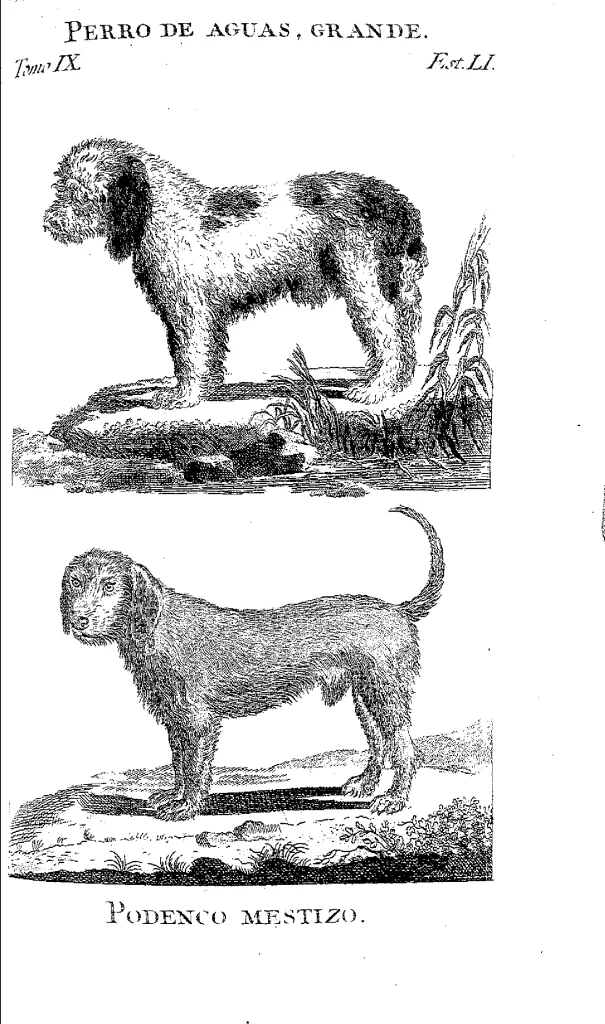
Water clock, large – Spain, 1790
A historical depiction of the “large water dog” (Perro de aguas, grande) published in the late 18th century. The engraving is an example of an ancient type of water dog mentioned in Spanish cynological literature long before the official establishment of the modern Perro de Agua Español breed.
Source: Historia natural, general y particular, Volume IX, 1790, Est. LI.
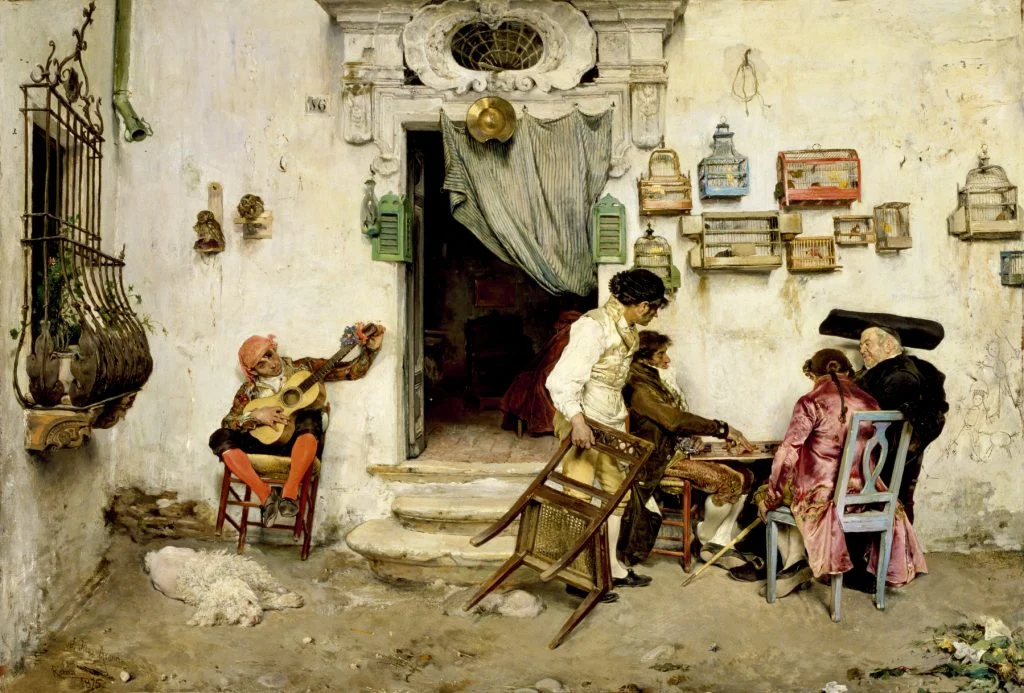
The Water Dog in 19th-Century Painting — 1875
A detail from the painting *Figaro’s Shop* (*La Barbería de Fígaro*) by the Spanish painter José Jiménez Aranda. The shaggy dog visible in the foreground is sometimes cited in studies on the history of the Turco Andaluz as an example of an old type of water dog.
José Jiménez Aranda, 1875. The Walters Art Museum. CC0.
Over time, the breed’s versatility began to be put to use in areas other than herding. In coastal regions, the dogs assisted fishermen by working in ports and on boats. They retrieved objects from the water, helped with nets, and thrived in the harsh conditions of the damp coast. Their thick, curly coat protected them from the cold, water, and wind, while also being practical for their daily work. For a long time, the breed was not uniform. Spanish Water Dogs were found in various regions of the country and adapted to local environmental conditions and the type of work they performed. It was not until the end of the 20th century that a more detailed analysis of the breed’s historical populations began. The research described in the 1998 paper “Diferenciación de ecotipos en el Perro de Agua Español” by C.J. Barba, J.V. Delgado, R. Castro, and P. Caballero proved particularly important. The researchers identified three main ecotypes of the historic Spanish Water Dog.
Marismeño — a breed associated with the marshlands of southern Spain, particularly the marismas, or wetlands, of Andalusia. Dogs of this type were well-adapted to working in water, moving through marshy terrain, and performing tasks that required swimming ability. In a study by Barby and colleagues, the Marismeña variety was identified as one of those showing a particular aptitude for water-related tasks. Chestnut-colored coats were more common among this variety.
Serrano — a mountain type that developed in the regions of southern Andalusia. These were stronger dogs more closely associated with herding work. Their build was well-suited to herding and long hours of work with sheep and goats in difficult, varied terrain. According to the authors of the study, the Serrana variety had the morphological structure best suited for the role of a herding dog, and black coat color was more common in this group.
Norteño — the northern type, associated with the Cantabrian coast. This was a lighter dog, more closely associated with work in the water, fishermen, and the marine environment. Like the marismeño type, the norteña variety exhibited traits conducive to swimming and working in the water. The study also indicated that light-colored coats were most common in this variety.

The Water Dog in 19th-Century Painting — 1875
A detail from the painting *Figaro’s Shop* (*La Barbería de Fígaro*) by the Spanish painter José Jiménez Aranda. The shaggy dog visible in the foreground is sometimes cited in studies on the history of the Turco Andaluz as an example of an old type of water dog.
José Jiménez Aranda, 1875. The Walters Art Museum. CC0.
Over time, the breed’s versatility began to be put to use in areas other than herding. In coastal regions, the dogs assisted fishermen by working in ports and on boats. They retrieved objects from the water, helped with nets, and thrived in the harsh conditions of the damp coast. Their thick, curly coat protected them from the cold, water, and wind, while also being practical for their daily work. For a long time, the breed was not uniform. Spanish Water Dogs were found in various regions of the country and adapted to local environmental conditions and the type of work they performed. It was not until the end of the 20th century that a more detailed analysis of the breed’s historical populations began. The research described in the 1998 paper “Diferenciación de ecotipos en el Perro de Agua Español” by C.J. Barba, J.V. Delgado, R. Castro, and P. Caballero proved particularly important. The researchers identified three main ecotypes of the historic Spanish Water Dog.
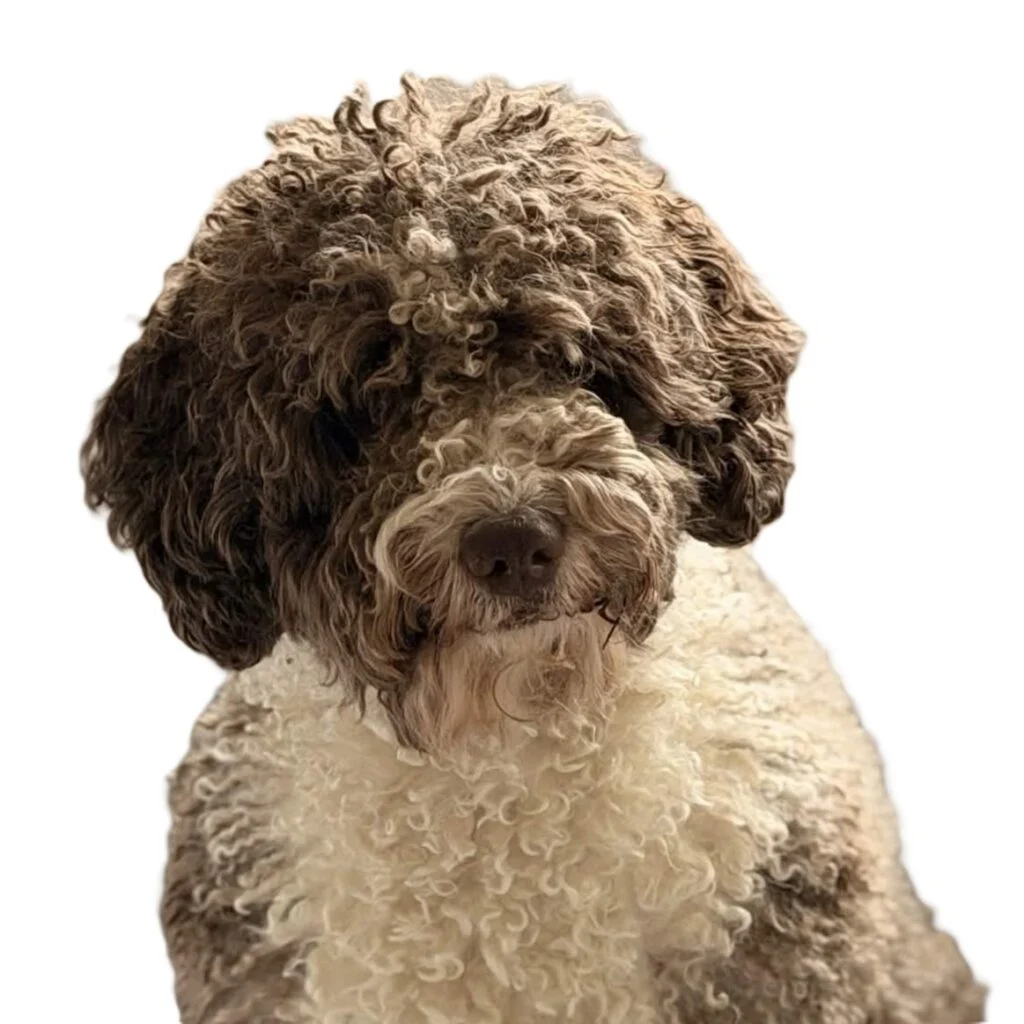
Did you know that a breed descended from the Spanish water dog is being developed in Spain? It’s a white variety known as the Perro de Agua del Cantábrico. These dogs come from Cantabria, are distinguished by their white, woolly coat, and are associated with working in water.